





2026 Top 100 Retailers
)
2026 Top 100 Retailers List
NRF's Top 100 Retailers ranks the industry’s largest companies according to sales.
View the complete chart.
Stop if you’ve heard this one: Walmart leads the NRF Top 100 for 2026, followed by Amazon. There’s a reason that may seem familiar; the top two have been unchanged since 2019.
This year, however, brings even more stability. There’s only one change in the top 20: Ace Hardware takes the place of Dollar Tree, which fell from No. 19 to No. 29 after shedding Family Dollar and seeing a 38.9% drop in store sales.
Kantar compiles NRF’s annual Top 100 list, based on U.S. retail sales the previous year. As the largest retailers continue to expand outside of retail revenues, this list focuses only on retail-specific revenues and not overall organizational revenue.
Overall, retailers are “finding a strong message,” says David Marcotte, Kantar senior vice president. “Companies are doing quite well. They’re also expanding into new business areas like retail media. They look to leverage their size as opposed to being held back by it.”
Stability does not equal stagnation
While the top 20 ranking is stable, there is movement within, though it wasn’t enough to change the rankings. CVS Health Corporation (which held steady at No. 6) sales growth jumped 11.9%, buoyed by its foray into a whole health approach. Costco Wholesale (steady at No. 3) was the other growth star in the group of 20. Walgreens Boots Alliance (No. 7 this year and last) saw its U.S. store count drop by 6.4% and Best Buy (No. 18 both years) by about 3.2%.

Most of the movement occurred outside of the top 20. Stability in the top of the rankings and movement in the mid-tier shows “that retail is constantly evolving and growing,” says Mark Mathews, NRF’s chief economist and executive director of research.
“While we’re not seeing change at the top, there is change down below as companies evolve and grow. And it’s much easier to do that in this environment than it was 20 years ago.”
Grocery’s regional power shift
The Kroger Co. (No. 4) remains enormous at $154.7 billion in U.S. sales, but its growth was modest (2.62%) and store count was flat in 2025. Publix Supermarkets (No. 12) and H.E. Butt Grocery (No. 16) are expanding faster, with Publix seeing 5% sales growth and H.E.B. seeing 6.3%.
Aldi (No. 14) saw a slight contraction in store count (down 0.8%) after years of relatively aggressive growth. Aldi includes Trader Joe’s; this year’s store count included the acquisition of Harvey’s and Winn-Dixie.
Where the action is
If the top of the list is about scale, the middle is about strategy. And Dick’s Sporting Goods has hit a home run, thanks in part to its acquisition of Foot Locker. That drove Dick’s to No. 27 on the list (up from No. 35 the previous year) and a whopping 48.5% increase in U.S. sales — the largest in the Top 100.
Marcotte sees it as an example of successful consolidation. “Dick’s has been able to expand outward,” he says. “If there is real synergy, the growth is there. Dick’s definitely hit that one.”
Dollar Tree’s divestment of Family Dollar impacted Dollar Tree’s sales and store count. But as a new-again standalone entity, Family Dollar found its way back onto the list, landing at No. 43.
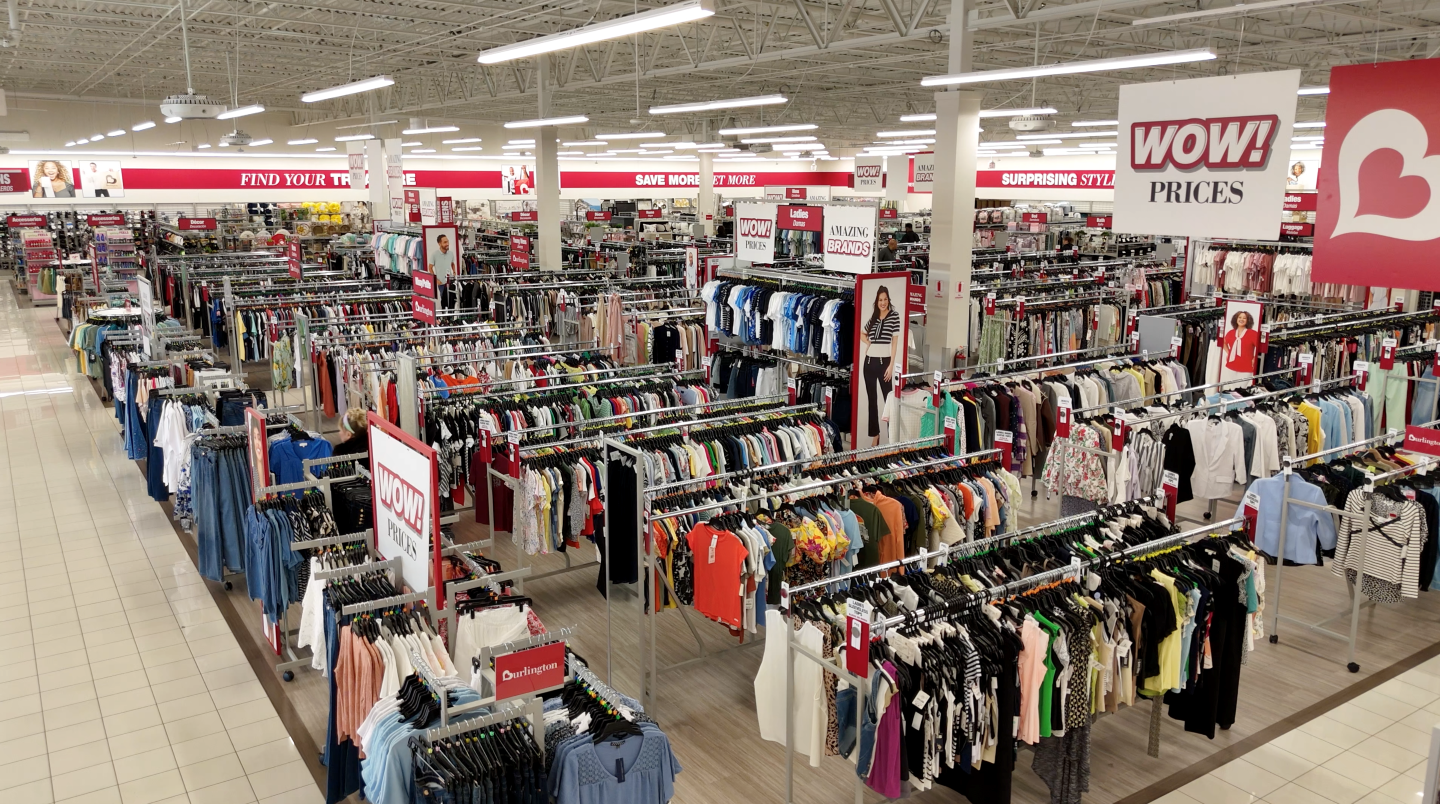
Off-price retailers TJX, Ross and Burlington also posted solid, steady growth. TJX (steady at No. 15) saw its sales increase by 6.3% and its store count grow by 2.6%. Ross Stores (No. 22, up three spots from the previous year) performed just slightly better, growing at 7.56% and increasing its store count by 3.6%. Burlington (No. 45, up from No. 47 last year) saw 8.8% sales growth and an increase in store count of 9%.
Traditional department stores Macy’s (No. 25) and Kohl’s (No. 34) saw slight dips, though lower than the previous year.
Marcotte believes the traditional department store is recalibrating as part of a mall resurgence. “The B‑ and C‑grade malls have come back very nicely,” he says. Abercrombie & Fitch (No. 99), up 7.9%, is his favorite example of a brand that used the mall’s revival to reinvent itself. A&F, a 2024 Hot 25 entry for its record-setting sales, was able to return to the Top 100 for the first time since 2011.
Win or learn
Even companies that saw significant declines have something to flaunt, Marcotte says.
Physical retail for telecom is rightsizing, with Verizon Wireless (No. 24) posting a 22.19% decline in store count and AT&T Wireless (No. 23) also facing a declining store count at 2.2%. Both companies, however, saw double-digit sales increases.
The rise of the quiet giants
Sherwin‑Williams (No. 39), Tractor Supply (No. 32) and Ulta (No. 41) all posted steady, disciplined growth.
Tractor Supply, Marcotte says, “offers an accessible format for ranch, farm and exurbs.” Their secret weapon? Chickens. “Everybody has backyard chickens and they own that business.”

Sherwin-Williams, Ace Hardware (No. 19) and True Value Co (No. 67) are good examples of where catering to consumers’ everyday maintenance needs can lead to success, Marcotte says.
Chewy (No. 40), Wayfair (No. 46) and Overstock.com (No. 88) represent what Marcotte calls “post‑COVID maturity,” posting solid but steady growth after leaping ahead during the pandemic.
Five Below (No. 89) posted 22.9% sales growth and an increase in store count of 8.5%.
The NRF Top 100 Retailers list tells many stories of retailers facing incredible obstacles and still managing to grow. But one thing Marcotte is watching for the future is the U.S. population, which could end 2026 with a decline for the first time since the Great Depression.
“Retail in the U.S. depends on the population expanding,” Marcotte says. “I know what happens in other countries when the population declines: Retail starts having to adjust very quickly.”
The top retailers have proven that they are able to do just that. Those that don’t may find themselves shaking up the list for next year.