





How LVMH balances luxury and innovation in the digital age
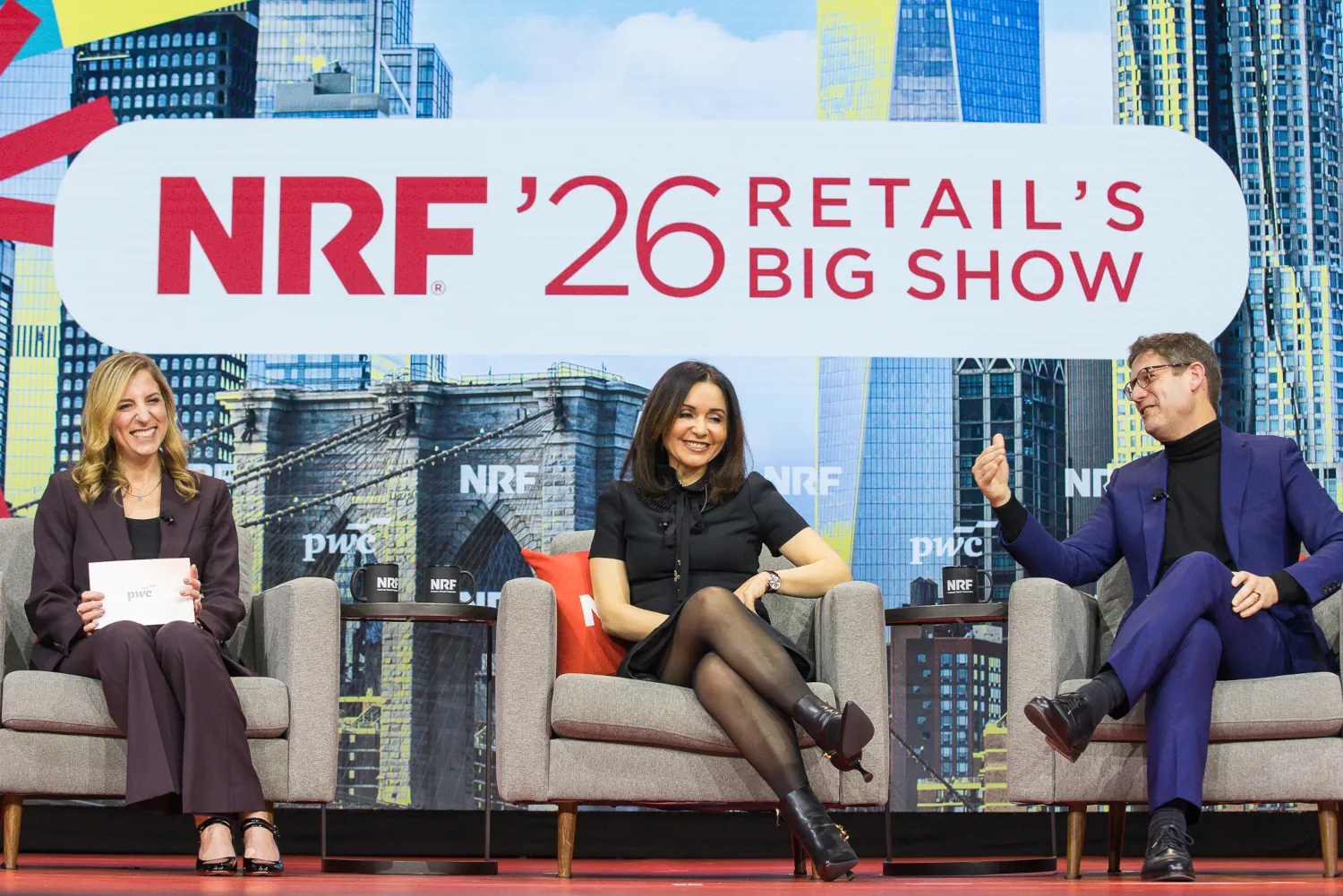
From left: PwC's Ali Furman, Louis Vuitton's Soumia Hadjali and LVMH's Gonzague de Pirey speak at NRF 2026: Retail's Big Show.
Luxury is where the personal touch is expected, where customers are known and their specifics catered too. Then how is it that one of the world’s biggest luxury brands LVMH — and its Maison Louis Vitton group — is on the leading edge of the digital revolution?
Retail's Big Show
Stay up-to-date on the latest news and articles about Retail's Big Show.
In a session at NRF 2026: Retail’s Big Show, Ali Furman, partner, U.S. Consumer Markets Industry Leader, PwC, dove into that topic with Gonzague de Pirey, chief omnichannel and data officer at LVMH, and Soumia Hadjali, global senior vice-president, client development and digital at Louis Vuitton.
Furman said she had been impressed two years ago, hearing de Pirey talk about LVMH’s AI strategy. “I remember walking into the room expecting to hear about efficiency, productivity gains, automation and cost takeout,” she said. “Instead, what he talked about was humanity, about how designers, artisans and clients were really at the center of his strategy. And the purpose of technology was not to replace anything that they were doing, but to retain the magic of what they were doing.”
For his part, de Pirey admitted the perceived disconnect in the world’s largest luxury company investing so heavily in technology that is perceived to reduce, if not remove, the human touch.
“Luxury is all about human. It’s about artistic creation. It’s about handcrafting. It’s about human commerce done mostly in the stores with client advisors, having a personal relationship with every client,” he said. “If we want to develop successful technology, the technology needs to be everywhere, but visible nowhere.”
The company’s AI strategy is about enhancing company values and allowing humans to do what they do even better. Each of the 75 Maisons, which is how LVMH divides the multiple brands within its portfolio, has its own AI transformation plan. But de Pirey found commonalities in commerce, marketing and operations, and an ability to share best practices in one Maison to another.
Still, there is care given to creativity, a “very sensitive topic that we tackle with a lot of passion, because this is so fascinating to us in the luxury industry. But also with some prudence, with some cautiousness, because we know that AI has a risk, in terms of creativity, to flatten the creativity.”
Hadjali said Louis Vuitton designers use AI tools to visualize materials and test colors “so that they can really focus their time on exploring, testing, creativity, emotions, craftsmanship and the narrative behind the products.”
"If we want to develop successful technology, the technology needs to be everywhere, but visible nowhere."
The company also uses artificial intelligence to generate assets for the ecommerce site, but never gets between a client advisor and a client. “It’s more about augmentation, not automation,” she said.
Agentic automation, while still in its infancy, could create an “intelligent layer to superpower our client advisor,” Hadjali said. “It’s mainly about anticipating, understanding, interpreting, responding to our client’s intent and building, at the same time, trust, legitimacy — all this powered by AI.”
While the brands may share technology and best practices, the intention is to keep each Maison authentically its own, de Pirey said. “That’s key for the success. Each time we have started to develop a gimmicky thing or things that are side topics, basically we fail to scale. On the contrary, where we have piloted a project that has been very successful to serve business needs that have tangible results, then the scale was not that difficult.”