





How agentic AI is redefining the future of retail
)
From left: PwC's Ali Furman, NRF's Bill Thorne and Stripe's Barbara O'Beirne on the Retail Gets Real podcast at NRF 2026: Retail's Big Show.

Barbara O'Beirne, Head of Global Enterprise Business Development, Stripe
Live from NRF 2026: Retail’s Big Show in New York City, Ali Furman, partner and U.S. consumer markets industry leader at PwC, and Barbara O’Beirne, head of global enterprise business development at Stripe, join Retail Gets Real for a wide-ranging conversation on how artificial intelligence is rapidly moving from experimentation to execution — and what that means for retailers right now.
Near the Expo floor buzzing with robots, AI demos and next-generation technology, Furman and O’Beirne unpack why agentic AI represents a structural change rather than a passing trend. Unlike earlier generations of AI that primarily assisted with search and discovery, agentic AI is designed to act. It can evaluate options, make decisions and increasingly transact on behalf of consumers. They say this evolution is reshaping the very top of the shopping funnel and redefining how consumers decide what to buy.
Agentic AI as a new front door to retail
Furman says consumers are beginning their shopping journeys with AI agents rather than traditional search engines or retail websites. These tools interpret intent, compare trade-offs, and guide high-consideration decisions — from health and wellness purchases to everyday essentials. As trust in artificial intelligence grows across generations, including Generation X, agent-assisted purchasing is becoming more mainstream, signaling a fundamental shift in consumer behavior.
Commerce inside AI experiences
O’Beirne expands on how commerce itself is moving into AI-native environments. Consumers are no longer just researching products in conversational interfaces like ChatGPT or Copilot; they increasingly expect to complete transactions in the same place. For retailers, this creates both urgency and opportunity. Success will depend on meeting customers where they already are, while delivering the same frictionless, trusted experiences they expect from traditional channels.
What this means for stores and experiences
Rather than signaling the end of bricks-and-mortar retail, both guests emphasize a redefinition of the store’s role. Physical locations may serve more as experiential hubs, showrooms, and brand touchpoints, while transactions happen elsewhere — sometimes invisibly, through AI-driven replenishment or delegated purchasing. Younger generations, digitally native and hungry for new experiences, continue to seek in-store engagement even as sales increasingly decouple from foot traffic.
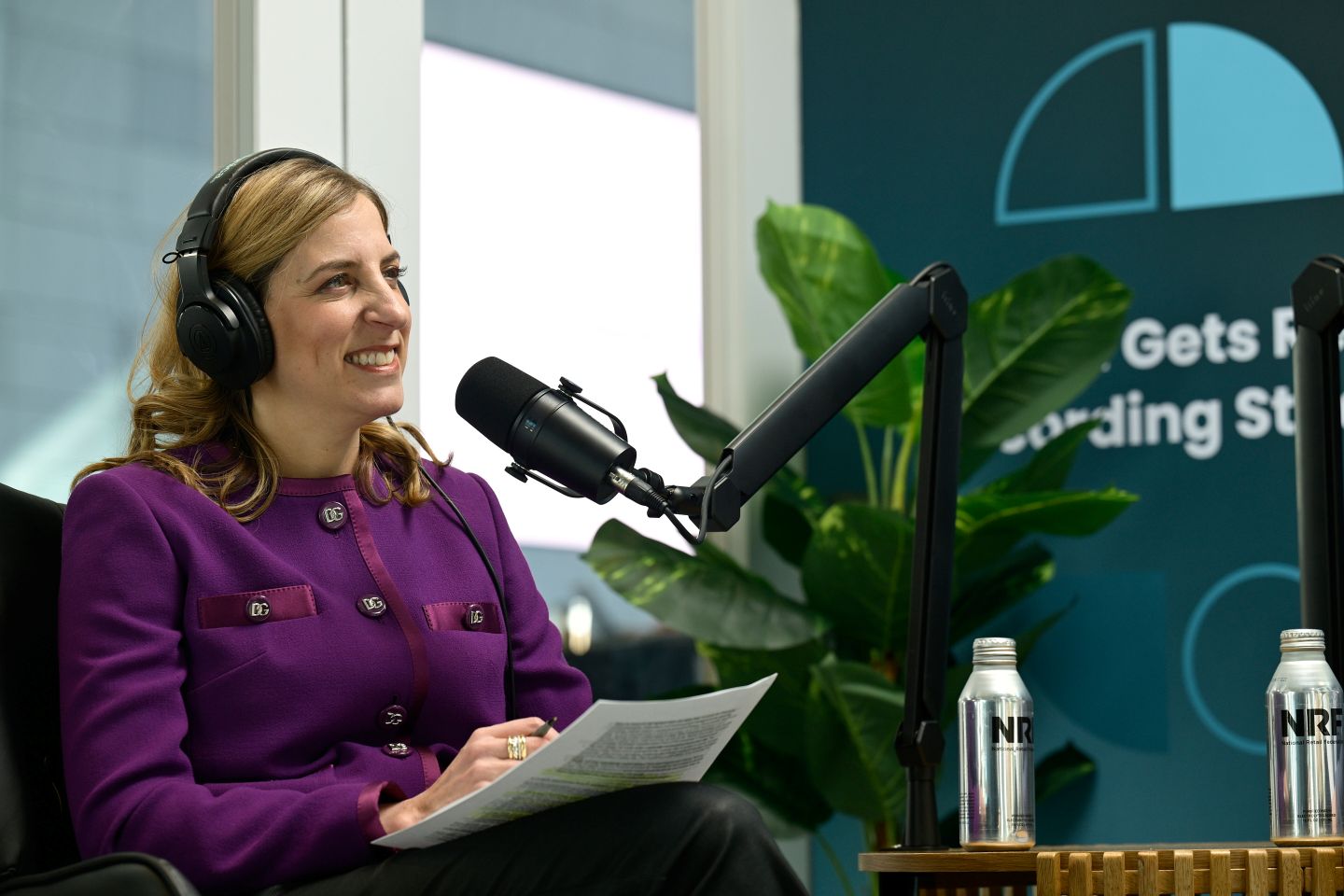
Ali Furman, Partner and U.S. Consumer Markets Industry Leader, PwC
From experimentation to execution
Furman and O’Beirne also discuss a strategic partnership between PwC and Stripe, designed to help retailers move faster from pilot programs to real-world implementation. Furman stresses the importance of making AI a core business strategy, not just an IT initiative, while O’Beirne highlights the need for infrastructure that abstracts complexity, preserves trust and keeps retailers in control as merchants of record.
A consistent message emerges: No one has fully figured this out yet, and that’s OK. The pace of change is unprecedented, but early experimentation, thoughtful pilots, and strong leadership can position retailers to adapt and grow. As agentic commerce accelerates, the retailers that succeed will be those who move with speed, flexibility and a clear focus on customer outcomes.
Episode chapters
(00:00:00) Why agentic AI is everywhere at NRF 2026
How this year’s Big Show signals a turning point for artificial intelligence in retail
Why the conversation has shifted from experimentation to execution
What “agentic AI” really means and why it’s different from GenAI
Why retailers are starting to see AI as a brand-new shopping channel
(00:04:07) How commerce is moving inside AI conversations
Why Stripe sees agentic commerce as an infrastructure shift, not a feature
The difference between autonomous AI buying and commerce inside AI tools
How consumer behavior is changing from search to conversation
What it means for retailers to sell where decisions are now being made
(00:06:47) Why agentic commerce is a structural shift, not a trend
How AI is moving to the very top of the shopping funnel
Why trust in AI purchasing is growing across generations
What’s missing today and how the experience will evolve
Why this shift could rival ecommerce and bricks-and-mortar alike
(00:09:39) How will agentic AI impact bricks-and-mortar retail?
Why physical stores could evolve into experience and brand hubs
The idea of stores as marketing investments, not just sales channels
How AI could push everyday shopping behind the scenes
Why in-person retail still matters to digitally native generations
(00:12:02) How PwC and Stripe are helping retailers move from pilots to reality
Why this partnership is designed to turn strategy into execution
How retailers can experiment without adding unnecessary complexity
Why so many leaders feel “behind” — and why that’s not a failure
What it really takes to keep up when change moves at cultural speed
(00:18:05) Where retail leaders should start with AI right now
Why AI must be a business strategy, not just an IT initiative
How intentional pilots lead to real ROI and momentum
Why adoption is more about people than technology
What separates winners as commerce becomes more distributed
Resources:
Learn more about PwC and Stripe's strategic partnership
Become an NRF member and join the world’s largest retail trade association
Learn about retail advocacy at nrf.com/advocacy
Find more episodes at retailgetsreal.com
Read Full Transcript
Episode transcript, edited for clarity
[00:00:01] Ali: The user experience is going to improve. The other thing I think that will improve is, right now it’s a very transactional-focused capability to improve frictionless buying, and to make your life more efficient.
[00:00:12] But eventually we’re going to see this technology evolve into inspiring loyalty and inspiration and emotion, which some of the luxury retails, in particular, are going to really capitalize on. So it’s a really neat space to watch.
[00:00:27] We think five years from now, the first native AI generation, Gen Alpha, is really going to propel this channel into parity with ecommerce as we know it today, and brick-and-mortar as we know it today, in the same way millennials did so for ecommerce.
[00:00:43] Bill: Welcome to Retail Gets Real, where we hear from retail’s most fascinating leaders about the industry that impacts everyone, everywhere, every day. I’m Bill Thorne from the National Retail Federation, coming to you from NRF 2026, Retail’s very, very Big Show in New York City.
[00:01:02] And on today’s episode, we’re talking to Ali Furman, partner and U.S. consumer markets industry leader at PwC, and Barbara O’Beirne, head of Global Enterprise Business Development and CEO of Stripe, Europe. We’re going to talk to Ali and Barbara about the significant impact agentic AI is having on the retail industry, both today and beyond, and how the two companies are partnering to guide retailers into the future. Ali and Barbara, welcome to Retail Gets Real.
[00:01:30] Ali: Thanks, Bill.
[00:01:31] Barbara: Thanks. Excited to be here. Thank you.
[00:01:33] Bill: So what do you think of the Big Show? It’s big.
[00:01:36] Ali: It’s amazing.
[00:01:36] Bill: It is amazing, isn’t it?
[00:01:37] Ali: Energy is contagious. Just so many great conversations, so much AI everywhere. Robots are everywhere, and I feel like they’re reaching a state of maturity too, from where we saw them last year, and they’re going to be able to do a lot more.
[00:01:51] Bill: For sure. So this isn’t your first.
[00:01:53] Ali: No, not my first part.
[00:01:54] Barbara: Not my first year either. But again, it just gets better every year. It’s interesting. I’ve been thinking about what this was like 12 months ago, and some of the conversations we had 12 months ago were around AI, but a lot of it was thinking about backend processes and how do I automate my systems, some customer service.
[00:02:12] But now all the conversation is about agentic commerce, and it’s just incredible the speed of change within. And I think it’s great to come to NRF because it’s a real mark in the sand every year of what’s been changing. And the speed of change this year has just been incredible.
[00:02:25] Bill: It has been. And I think the theme, as we were thinking about that a year ago, the theme of next now really does pertain. The change is moving so quickly. Just keeping up with it isn’t very easy. And that’s what I want to talk about. I want to talk about agentic AI. Now Ali, when you use the phrase agentic AI, what exactly does that mean?
[00:02:47] Ali: Well, I agree with Barbara. Agentic AI is probably the busiest term in retail right now. What I view it as is, it’s AI that acts, not just advises. Most Gen AI tools that we’ve had prior to agentic AI were co-pilots that could help you search and compare and discover. And now agentic AI goes even further than that.
[00:03:09] You can give it a goal. It can help you browse options, help you evaluate trade-offs, and increasingly, it can complete purchases on your behalf. And that is what was the most exciting innovation that probably came faster than any of us expected in the last 90 days or so.
[00:03:25] Barbara: Yeah.
[00:03:25] Bill: What recent innovations have made agentic AI more viable now? Where are we seeing retailers feeling that shift first?
[00:03:35] Ali: Yeah. First of all, the models improved dramatically. It’s now much better at reasoning and planning and maintaining context across multiple steps than it ever was, even a month ago. That seems to be evolving every single day. Second, the commerce and payments infrastructure caught up, and that’s where partners like Stripe come in.
[00:03:55] They really helped accelerate the ability for the payment infrastructure in particular to catch up to the consumer interest in using AI as a commerce assistant. And then third, we’re seeing an emergence of controlled autonomy, is how we describe it. So consumers are more willing to transact through AI.
[00:04:12] They’re trusting it more and more. I think this is being propelled by younger generations like Gen Alpha and Gen Z in particular. But millennials are using it more and more for convenience and everyday life and commodity purchases. So I think the consumer is starting to be a little less skeptical.
[00:04:26] And retailers first felt this shift earlier on in discovery, and now we’re seeing a new phase of commerce where it’s not just being used identically. LLMs are not just being used to help discover. They’re being used to transact. And we see this as a new front door of retail, brand-new shopping channel.
[00:04:45] Bill: Yeah. Barbara, you are definitely thinking about this all the time. How do you think about agentic commerce? Where do you see it already showing up?
[00:04:56] Barbara: I think before I even get into agentic commerce, Stripe is an infrastructure company that is built to move money around the world. We create the infrastructure for platforms, for direct enterprises, for startups, for marketplaces, across payments, billing, a whole bunch of ways to move your money. And last year we moved $1.4 trillion. Businesses—
[00:05:17] Bill: That’s a lot of money.
[00:05:18] Barbara: —on Stripe generated this much. It’s up about 40%. So we see that commerce is happening at an accelerated rate online, but also in store. So we take this mindset of creating the infrastructure to move money frictionlessly across borders to how we think about agentic commerce.
[00:05:35] And we think about it primarily in two ways. One is autonomous agentic AI, where the commerce is happening on behalf of the buyer — and that could be a consumer, and it could be a business. The other way that we’re thinking about, and I think this is where more of the conversation has evolved over the last six months particularly, is commerce that happens in an AI surface.
[00:05:56] So that may be OpenAI or ChatGPT. It might be Copilot now, which we’re now partnering with Gemini. All of these areas where the consumer behavior has changed, Ali’s point. Before, I think we’ve gotten quite used to in the last 20 years of going into a search engine and looking for something, searching some keywords, doing a browsing, considering it coming back.
[00:06:18] Now the search and evaluator is happening in a very, very different way, and it’s a conversation. And the big advance we’ve seen in the past six months particularly, is now that commerce can happen in the same surface. So it’s not that I think there will be a lot of evolution and we’ll continue to innovate around that autonomous agentic part, but now a lot of the conversation is how can I ensure I meet my customers where they are?
[00:06:39] My consumers are in ChatGPT. They’re in Copilot. They’re in Gemini. That’s where they are having a deep conversation and making the evaluation. How can I ensure we take the same mindset of beautiful customer experience — frictionless commerce — and enable them to act in the same surface and not be redirected?
[00:06:57] So for retailers, I think this creates an interesting, new disruption. And really, the speed of disruption has been so fast, it’s “How do I play in this space? How do I start to interact?” And I think there’s a lot of conversation that’s happening at the moment, all the way from “How do I surface my products here?”
[00:07:14] And what we’re deeply thinking about in Stripe is when your product is surfaced, how do we help you to facilitate that commerce to ensure it’s as frictionless and as beautiful as possible?
[00:07:24] Bill: That’s awesome. So Ali, you’ve described agentic commerce as a structural change, not a passing moment. Tell us more about what that means.
[00:07:34] Ali: Yeah. We think this is a structural versus a cyclical change or a flash-in-the-pan change for a few reasons. First, AI is moving to the top of the shopping funnel, so consumers are increasingly starting with the AI agent on their product discovery journey, which is exactly what Barbara was describing.
[00:07:53] And they’re using it to interpret their intent, to evaluate trade-offs. They’re comparing prices. They’re having a conversation. This is especially happening for what we would describe as high-consideration purchases. And that doesn’t just mean very expensive purchases, but it can mean something that’s important to your wellbeing or your health or self-improvement related things.
[00:08:16] The most important decisions in someone’s consumer life are happening with the help of AI, and that’s new. That’s really new. Second, this behavior, it’s becoming mainstream. I mentioned the younger generations are using ChatGPT in particular. I think 67% of people age 13 to 34 are using ChatGPT almost daily, which is a staggering statistic.
[00:08:38] Bill: It is.
[00:08:38] Ali: But by 2030 we anticipate close to 50% of Gen X is going to allow AI to purchase on their behalf. We’re surveying all the time, all the different generations. How much do you trust AI? What would it take to allow you to delegate purchases to AI? And even Gen X, who’s been a little bit behind some of these younger generations, they’re saying, “It’s things like a money-back guarantee or the ability to approve a purchase before it happens, or to turn it off at any time.”
[00:09:07] These aren’t insurmountable hurdles to trust the AI agent to purchase on your behalf. So we think that it’s coming. And our broad prediction is we’re in the early innings. The user experience isn’t optimal yet, doesn’t yet connect merchant data to— for example, if you’re a Walmart customer, your merchant data as a Walmart customer isn’t yet connected to your purchase that you make of a Walmart product in ChatGPT.
[00:09:29] So your purchase history doesn’t carry over. Your loyalty points don’t carry over. But that’s going to change and evolve. So the user experience is going to improve. The other thing I think that will improve is right now it’s a very transactional-focused capability to improve frictionless buying, and to make your life more efficient.
[00:09:46] But eventually we’re going to see this technology evolve into inspiring loyalty and inspiration and emotion, which some of the luxury retails, in particular, are going to really capitalize on. So it’s a really neat space to watch. We think five years from now, the first native AI generation, Gen Alpha, is really going to propel this channel into parity with ecommerce as we know it today, and brick-and-mortar as we know it today, in the same way millennials did so for ecommerce.
[00:10:16] Bill: That’s amazing. And again, it will probably initiate that conversation that I hate so much, which is, will this be the death of brick-and-mortar?
[00:10:26] Ali: We don’t think so. I’m curious of Barbara’s thoughts. We think it may just— and it’s different for different types of products and categories, of course. I think there’s no way luxury retail goes away as an experiential lifestyle purchase in a store. Talking to my chief economist recently, she had a recommendation that many retailers should consider the brick-and-mortar store as a marketing expense.
[00:10:49] Bill: Oh, wow.
[00:10:49] Ali: Because in the future, it may serve that purpose more than anything else, as a showroom or a branding opportunity for a product versus a place to transact. I don’t know that I agree with that extreme for everything, but I think for commodity categories you can certainly see it moving in that direction. Why not delegate your agent to buy you replenishment type items like eggs and milk and toilet paper? Just that should be invisible shopping behind the scenes.
[00:11:17] Barbara: And I think that trend has been ongoing for a while. It will accelerate potentially with the use of agentic commerce, but the notion of the store as a place to come and experience my brand, to touch and feel it, to have a sense of joy, I think the younger generations are spending so much time on screens that they crave that in-person touch, and a lot of their weekends are spent going to stores with their friends, having an experience.
[00:11:40] And the commerce might not happen there. The commerce might happen elsewhere, but agentic will be part of that mix. And I think that’s a disruption that’s been ongoing for quite a while, and retailers are still getting their arms around it. But the ones that do it well when you walk into a store, just the sense of craft and beauty can be exceptional.
[00:11:58] Ali: Couldn’t agree more. I think the younger generations, we say they’re very paradoxical, because they’re digitally native, but they love shopping in stores to touch, feel, sense all the things. However, although their foot traffic increases month over month, for the most part, in brick-and-mortar stores, their sales don’t correspond with that.
[00:12:14] So this is where you think about the store of the future and what is the purpose of it? Is it really meant to capture their wallets, or is it meant to just give them an amazing experience? We also know experiential services in general as a category are going up. That’s a big prediction for ‘26. Like services that relate to wellness and spa and functional medicine and wellbeing, they’re all growing exponentially already, and will continue to do so into this new year.
[00:12:40] Bill: Let’s talk about the partnership. So this is a pretty new partnership. October, I believe, of last year. So weird to say last year. It seems like it was just yesterday. But anyway, tell us about the PwC and Stripe strategic partnership, and how do you help retailers move from strategy and experimentation into real execution, Ali?
[00:13:00] Ali: Yeah, so we are so excited to be partnering with Stripe in this emerging agentic commerce space. It’s a great partnership. So from the PwC side, we bring what I would describe as speed to value for end-to-end value chain expertise. Stripe is the payments infrastructure.
[00:13:18] They’re innovating every day, expanding their stack. We come in across merchandising, pricing, digital supply chain and payments, helping retailers build those capabilities and connect them to pieces from strategy into action efficiently without creating complexity. And it really all starts with pilots.
[00:13:36] I think this is something we agree adamantly on. This is a space that isn’t going away, that everyone should be experimenting with, and it’s inexpensive to pilot. And to partner with people like Stripe and with us, to do it early, you can learn so much from piloting and then figure out your further investments from there.
[00:13:54] Bill: Barbara, from your perspective, from Stripe’s perspective, what capabilities does Stripe bring to that partnership?
[00:14:02] Barbara: One of the things I love about working in Stripe is it is an incredibly innovative place to work. It feels like I’m working in a different company every six months. And we are in such a privileged position at the moment that we are working so deeply with AI agents and AI platforms. We’re working with— 80% of the top AI startups in the world are built on Stripe.
[00:14:22] We are working with platforms at retailers, and it puts us in this position where we can really start to cross populate trends that we’re seeing in even B2B software, where there’s innovation happening there with AI through the startups and platforms. So with that, we are advancing our capabilities, and we’re building that infrastructure.
[00:14:38] And we’re trying to abstract away the complexity for retailers so that they don’t have to worry about all of the areas and all of the plumbing under the hood. But for many retailers, I think the world is changing so fast, and it can feel— it’s funny. What I’ve heard a lot from retailers of all sizes over this weekend is we feel like we’re so far behind. And everybody feels like they’re so far behind.
[00:15:00] So as an infrastructure company, as a highly innovative financial services and technology company, our partnership with PwC allows retailers to access that level of innovation and to think it through from, “What is our strategy? How do we prioritize? Where do we go next?” And then we can come in and help with that conversation on where to prioritize, how to get ready, and really marry the “what should we do” with the “how.’
[00:15:25] Bill: Right. It’s really interesting when you say that you talk to these folks and they’re like, “We already feel like we’re behind.” Will anybody ever feel like they’re ahead? It just seems to me that because the technology and the innovation is moving so quickly, are you really ever going to capture the whole breadth and depth of what this means to your business?
[00:15:48] Barbara: I don’t know. I’ve been working in retail technology for a long time, and I think back into what feels like the distant past now, in the early 2010s when search and mobile were really starting to coalesce. I think retailers had time to think through, what’s this going to mean for me? How am I going to adapt my business to ecommerce? How are we going to manage SEO?
[00:16:09] Bill: Right.
[00:16:09] Barbara: And consumers were learning as well. I had a Blackberry in 2010. Think how far we’ve come. I remember sitting with a retailer a long time ago at the time, and they were thinking, “I just don’t really think people are going to buy items this big online.”
[00:16:22] But if you fast forward now even 15 years, how much the world has changed, how much more educated and savvy the consumers are, the pace of change that we have seen in agentic commerce is nothing like I’ve ever seen before. So the disruption is coming. Retailers are innovative. They’re used to disruption and change. I think the speed of this is what is so different than what I’ve experienced in the past.
[00:16:43] Bill: Yeah.
[00:16:44] Ali: And it’s not just the technology driving the change. We always say the customer’s moving at the speed of culture. And customers are shifting from “Where should I shop?” to, “What should I buy?” And they are looking for outcomes. They’re shopping outcomes, not categories. So when you couple that together with the pace of technological change, no, I don’t think anybody is ever going to feel like they’re ahead.
[00:17:10] But I think that’s the goal. It’s the goal, not just to— we talk a lot about meeting the consumer where they are. The goal is to get ahead of the consumer and help them figure out what they want before they even know what they want. And I do think AI has the potential to help retailers get there.
[00:17:28] But the thing to maybe everybody— give themselves grace, we’re in such early innings. No one has this figured out. Even the players with the greatest scale that have moved first don’t have it fully figured out. They are moving fast and there absolutely will be first-mover advantages in this space. But eventually, people are going to iterate.
[00:17:46] We’re going to learn from others’ lessons and apply them to our own, and potentially have an opportunity to leapfrog. So I think the key is, just to reiterate a previous point, pilot. Just start experimenting.
[00:17:57] Bill: Yeah, yeah, yeah. It’s interesting because I’ve said it before. I still believe it. And the more conversations I have, it’s the breadth and depth and the potential for this technology and this innovation is just almost staggering when you try to capture it all in your mind and piece it out.
[00:18:16] And I always say it’s like the idea that the universe is infinite. I just can’t get my arms around that. So it’s got so much potential. Ali, what is your advice to clients looking to get started with AI? I know the piloting, but is there something that they can do to step by step, move into this space?
[00:18:38] Ali: Yeah. There’s a few pieces of advice we’d give retailers after the last 30 to 36 months of Gen AI being on the scene. I think we learned a lot through that initial period of experimentation.
[00:18:50] Number one, make AI part of your business strategy. So AI shouldn’t just be a technology strategy driven by your CIO or your IT department. It should in fact be driven by the top-down, and it should help accelerate your business strategy or empower your business strategy that you already have.
[00:19:12] Separately from that, we really believe in what has been referred to as a bimodal approach or a hybrid approach around getting AI into the hands of your teams, but do so in a very intentional way, not in a throw-spaghetti-at-the-wall way, and see what sticks. We’ve learned a lot around where the ROI is and what functional areas, what types of pilots have worked, which ones haven’t.
[00:19:34] So really take a page out of the book of those who have gone before you. A lot of other industry sectors were first movers before retail, like insurance and legal. There’s things to learn, even though those aren’t the same sectors. And take the low-hanging fruit that can give you real P&L outcomes and then use the savings that you may get to reinvest in innovation and growth.
[00:19:57] Bill: With all of that in mind, it’s the “What comes next?” For leaders who know AI matters, but they aren’t sure where to focus first, how do you help them to think through those priorities, Ali? Every business is different. And I’d be interested in your take on this too, Barbara, but every business is different. How do you get them engaged and excited about what the potential is?
[00:20:21] Ali: So what we say is scale matters. Speed matters more, and innovation matters most of all. And it’s not so much that it’s a question about technology or technology strategy. It’s a people challenge and a leadership challenge. It’s really the 80/20 rule there.
[00:20:42] The technology is amazing, and it’s going to continue to evolve at an astronomical pace. So it’s not going to be worth much if your teams aren’t adopting, if they feel threatened by it. So you have to really think about a strong change management strategy and a very strong top-down leadership approach.
[00:21:00] And then the other thing we’ve learned is you need to set accountability, KPIs and incentives around outcomes that you’re looking to achieve from your business strategy powered by AI. And with all of that, we should start seeing real tangible financial outcomes, both top- and bottom-line. And there’s nothing wrong with looking at it as an efficiency or productivity play.
[00:21:20] A lot of companies start there. But where we think the real value is, it’s on the top line. And that’s where many companies have only begun to scratch the surface. But that’s where this agentic commerce opportunity comes in. It’s a growth opportunity for sure.
[00:21:33] Bill: For sure. Barbara, what are your thoughts about that?
[00:21:36] Barbara: I think broader commerce is going to evolve in radical ways in the next few years. So I think commerce will be more distributed with more opportunities for merchants to sell, and it could be with AI agents across platforms. It could be in ways that we can’t even envision now that don’t feel like commerce.
[00:21:51] Some will be conversational. Some will be autonomous, like mentioned, and that’s already happening in a software space, just not as much in the consumer space. And I think the winners will be businesses that can do three things very well. First, they can make their products legible to AI.
[00:22:07] So we have optimized for a human-readable world that now needs to become machine readable. So Stripe has been involved in creating an open-source protocol, the agentic commerce protocol, to take your product catalog and ensure that your inventory, your pricing, your product descriptions are live and readable by AI agents. So get ready.
[00:22:25] I think that’s the first thing I would recommend to everybody. Even if you think you don’t want to participate right now in agentic commerce, get yourselves ready because it will come faster than you expect. The second thing for the winners, I think that will really start to do well, they will manage trust.
[00:22:41] When we started on the journey of building out the Agentic Commerce Suite, it was interesting when we talked to both the AI platforms and to big retailers. They had a very similar set of concerns. “Who will be the merchant of record?” “Does OpenAI want to do returns for the jeans and the socks you bought?”
[00:22:58] No, they don’t. So it’s ensuring that the retailers continue to have that control. They are the merchant of record. They maintain that trust because consumers also want to know who they’re buying from. So how do you ensure that you have trust built into the system, into the agentic commerce?
[00:23:12] Fraud is huge. How do you ensure that when the high-intent purchase is passed through to a retailer, that you are — and this is what Stripe has built with our shared payment token — that you’re passing through fraud signals. We spent a long time blocking bots. Now we’re saying to bots, “Come in and have a look at my website.” How do I know which are the good bots and the bad bots?
[00:23:31] So the winners will be the ones that continue to ensure that that trust, that the fraud, that that is all really well-baked into their systems. And third, they’ll be flexible. Because as we mentioned at the start, what we saw today or we’re seeing this weekend is so radically different than what we saw 12 months ago, and it will be very different in three months as well.
[00:23:50] So ensuring that as you’re building out your systems, as you’re thinking about your strategy, I think piloting is a great way to start and ensuring you have that flexibility. Because commerce will become more and more distributed, and you want to ensure, to Ali’s point, that you’re meeting your consumers where they are.
[00:24:05] Bill: All right, so I got the high sign. We’re just about out of time. I do want to ask you— so I’m not going to do the full rapid fire. Normally we do a full rapid fire, but I’m going to just ask you each one question. I’m going to start with you, Ali. What’s the last book that you read to completion?
[00:24:19] Ali: I just read a book called “The Heir Apparent.” It’s a fictional book loosely based on the royal family, and it was great.
[00:24:27] Bill: I actually know somebody who happens to be my spouse who was reading the same book.
[00:24:32] Ali: Yeah, it’s a fun one, like a beach.
[00:24:34] Bill: Yeah.
[00:24:34] Ali: Read it over the holiday break.
[00:24:35] Bill: Totally. All right. Barbara, what is your favorite podcast? And don’t say, “Retail Gets Real.”
[00:24:41] Barbara: Apart from Retail Real. As you can hear from my accent, I’m based in Dublin, and I cannot get enough of NPR. I listen to a huge amount of “This American Life.” But I’m an avid podcast listener because I have three kids. I spend a lot of time doing laundry, walking the dog. So “This American Life,” it’s just such an interesting human perspective.
[00:25:04] Bill: That’s a great one. It’s on my list. I enjoy it immensely. And the NPR ones are very, very good.
[00:25:10] Barbara: From a business perspective, I listen to “Acquired” a lot. I love the long form. So I think from “Acquired” you can really get into what the long story was about that. The Starbucks one is incredible, how Microsoft was formed. So I think those ones, when you have a lot of time and you can pick and choose it, I really, really enjoy “Acquired.”
[00:25:26] Bill: That’s totally awesome. All right. We’re going to have to do this again next year, both of you, because so much is going to happen over the next 365 days. The conversation will be very, very different. We’ll look back on this and be like, “Ha ha ha, we were—”
[00:25:40] Barbara: Seems so [Inaudible].
[00:25:41] Bill: Yes. That was nice, but it doesn’t even matter today. It’s been a pleasure talking with both of you. Ali, Barbara, thank you for being a part of Retail Gets Real.
[00:25:50] Barbara: Thank you so much.
[00:25:51] Bill: And thank you all for listening to another episode of Retail Gets Real. You can find more about this episode at retail gets real dot com. From Retail’s Big Show in New York City, I’m Bill Thorne. This is Retail Gets Real. Thanks for listening. Until next time.