




The rise of smart retail merchandising
)
BIG Digital's Jake Neiman on the Retail Gets Real podcast at NRF 2026: Retail's Big Show.
Technology is reshaping the in-store experience, and Jake Neiman is helping retailers bring digital innovation into the physical world. The co-founder and CEO of BIG Digital joins Retail Gets Real to discuss how immersive kiosks, smart merchandising solutions, AI-powered interfaces and next-generation ePaper displays are transforming how customers engage with brands inside stores.
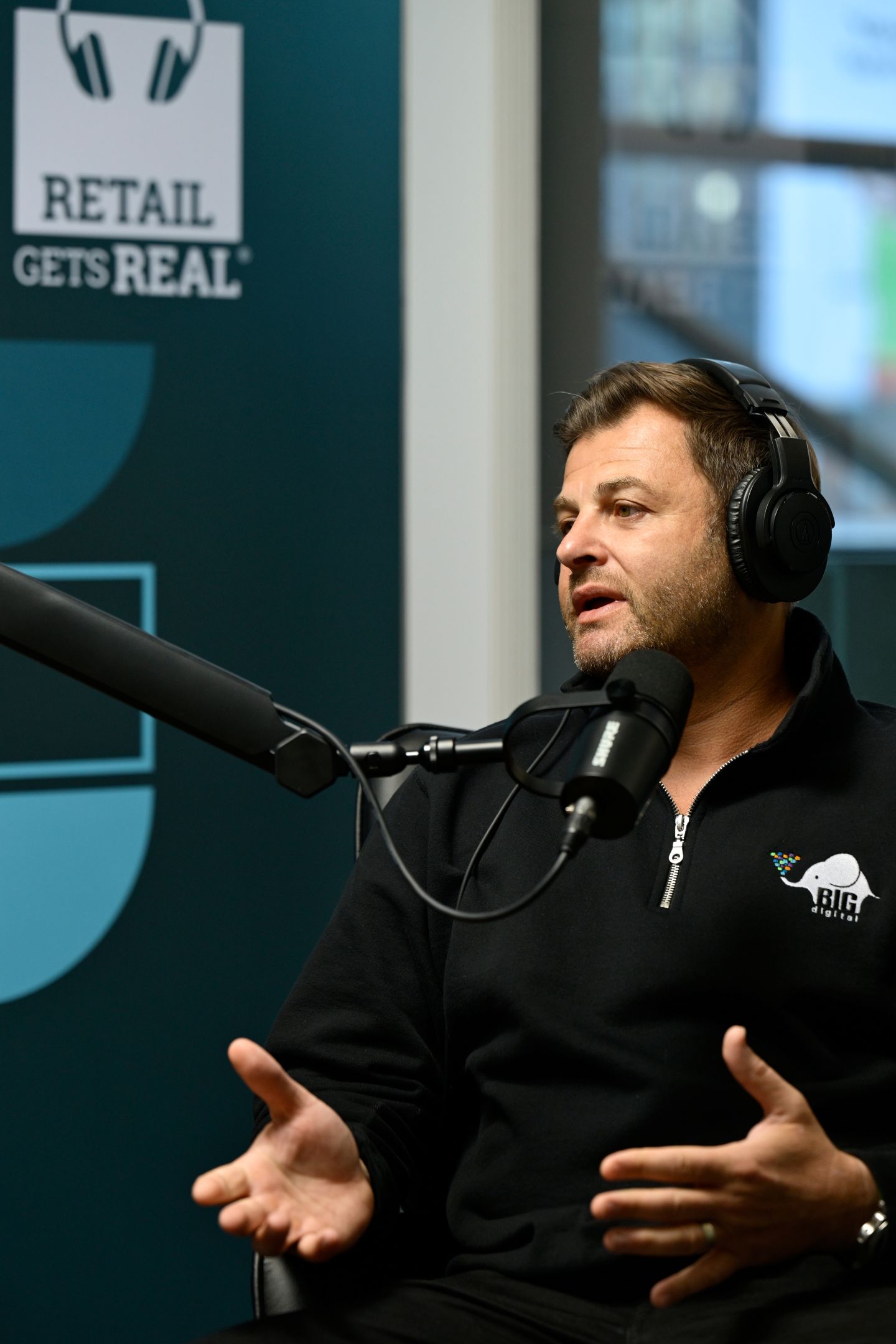
Jake Neiman, co-founder and CEO, BIG Digital
Reimagining engagement
Interactive kiosks and smart retail displays provide retailers with new tools to capture attention and drive sales. From portable battery-powered kiosks at store entrances to sensor-enabled “lift and sell” merchandising units that trigger product information when an item is picked up, Neiman says the goal is simple: Create meaningful engagement at the moment of decision.
Rather than replacing human interaction, he describes these tools as complementary. Some shoppers prefer speaking with associates, while others want to explore independently. Interactive displays offer product education, personalized recommendations and real-time information without friction.
AI plays an increasingly important role in this experience — practical AI applications include kiosks that can respond to customer inputs like size, fit preferences or specific needs, then recommend products instantly. Neiman says the key to adoption is simplicity: Retailers need solutions that are easy to understand, easy to deploy and clearly tied to sales performance.
Sustainability and the future of digital retail
Neiman also discusses how digital signage unlocks agility. Unlike static print materials, digital displays allow retailers to adjust messaging instantly, launch flash promotions and deliver timely offers that respond to real-time conditions.
One of the most promising developments is ePaper technology. Designed to dramatically reduce power consumption and eliminate the need for print materials, ePaper displays operate with minimal energy, including indoor solar charging.
Listen to the full episode to hear how experiential technology, AI integration and sustainable innovation are redefining what’s possible inside the retail store.
Episode chapters
(00:00:00) Powering live events with interactive kiosks
How kiosks help users navigate massive events
Turning digital displays into new revenue-generating assets
What it takes to engineer weatherproof tech for extreme environments
(00:04:38) Building BIG Digital during a global shutdown
Why launching an immersive tech company during COVID was a calculated risk
How turnkey hardware, software and analytics drive measurable retail ROI
Where physical retail meets AI-powered engagement
(00:07:04) Bringing immersive technology onto the sales floor
How portable kiosks and smart displays capture attention at the door
Why sensor-driven merchandising changes the product discovery journey
Balancing AI-powered self-service with the human side of retail
(00:11:26) What holds retailers back from adopting new tech
Why upfront capital costs can slow innovation at scale
How hardware-as-a-service models reduce financial risk
(00:12:56) What’s next for digital retail innovation
How ePaper technology could eliminate print for good
Why ultra-low power displays change the sustainability equation
Turning AI, mobile and in-store tech into one seamless omnichannel experience
(00:17:34) The future of retail belongs to immersive experiences
Why physical stores must compete with the ease of online shopping
How gamification and AI can surprise and delight customers
Resources:
Become an NRF member and join the world’s largest retail trade association
Learn about retail advocacy at nrf.com/advocacy
Find more episodes at retailgetsreal.com
Read Full Transcript
Episode transcript, edited for clarity
[00:00:01] Jake: Experiential technology, engagement, gamification, people having fun when they go to a store and get surprised and delighted with an experience they might not have expected, or again, getting product recommendations with a very intuitive, easy-to-use AI interface, the e-paper technology, which again brings true sustainability to market and where we can enable retailers and brands to bring true sustainability forward in a very tangible, measurable way, these are all things that get us excited.
[00:00:39] Bill: Welcome to Retail Gets Real, where we hear from retail’s most fascinating leaders about the industry that impacts everyone, everywhere, every day. I’m Bill Thorne from the National Retail Federation, coming to you from NRF 2026: Retail’s very, very Big Show in New York City. And on today’s episode, we’re talking to Jake Neiman, co-founder and CEO, Big Digital. We’re going to talk to Jake about his journey as an entrepreneur and how he’s pushing innovation in retail. Jake, welcome to Retail Gets Real.
[00:01:12] Jake: Thank you. Good morning.
[00:01:13] Bill: It’s great to have you, and I know you are a presence, and I know your company is a presence because right outside the staff office is one of your digital displays. And I’ve used it extensively. For some reason, years past, I’ve always had a calendar, what I need to do, where I needed to be, what was going on. This year I didn’t do it. And I don’t know why I didn’t do it, but I didn’t do it. I’m not so sure I’m going to ever need to do it again because of your technology. And so thank you for that.
[00:01:44] Jake: We have a special partnership and relationship with NRF, really proud of it, where we’re able to innovate the attendee experience with our touchscreen interactive kiosks. They’re portable, so they can be moved around wherever NRF needs them. We do this, a lot of trade shows, but of course across retail as well, and they provide real-time information about the show, diverse information.
[00:02:09] There’s wayfinding and a complete interactive map of the entire show floor. As you know, it’s a very big footprint, so navigating the trade show itself is challenging. So providing wayfinding and real-time information about the show, today’s schedule, “did you know” facts. Really immersive detailed information is available through those kiosks, as you outlined.
[00:02:31] So we integrate with NRF’s APIs. So as your app gets updated, as your website gets updated, our interactive kiosk gets updated as well. And then we have our outdoor grade portable digital kiosks, which are freestanding, plug-and-play. We install them in minutes, and they’re providing all the shuttle information.
[00:02:51] So NRF provides a great shuttle service to all the participating hotel partners, and our kiosks are providing all the information and root information, as well as monetization for NRF through fulfillment of sponsorship and partnerships.
[00:03:06] Bill: Now, I’m sure that somebody that’s from Toronto knows about cold.
[00:03:11] Jake: Mm-hmm.
[00:03:11] Bill: And so your outdoor monitors— now, we’ve been incredibly fortunate through the years. We’ve never had a major snow event, and I’ve just jinxed that, so I’m knocking on wood.
[00:03:20] Jake: At NRF in January. Yes, it is nice and mild.
[00:03:24] Bill: It’s amazing this year.
[00:03:25] Jake: Yeah.
[00:03:25] Bill: Your outdoor monitors, I look at the indoor. Are they susceptible to weather like—
[00:03:31] Jake: They’re completely weatherproof. We designed them. We patented them. They are purpose-built for very diverse outdoor use cases. Toronto is southern Canada. We’ve had them [in] northern Canada. We’ve had them like deep north of British Columbia, Saskatchewan. They’re purpose-built for -30 to +50. We’ve had these in the deserts of Dubai for golf tournaments. DP World Tour uses them on the golf course for real-time attendee engagement and fan information and fan engagement on the golf courses.
[00:04:17] And we’ve had them in Las Vegas during record temperatures. They’re really purpose-built for true outdoor use cases, and they’re portable, freestanding, but they’re wind-certified for 95-mile-an-hour winds.
[00:04:31] Bill: That’s amazing.
[00:04:32] Jake: So we’ve had them hit by category four hurricanes, and they’re ultra, ultra reliable.
[00:04:38] Bill: All right, so I know the product, but let’s talk about the company.
[00:04:41] Jake: Mm-hmm.
[00:04:42] Bill: What’s the background of Big Digital?
[00:04:43] Jake: We incubated the company during COVID and we did our first seed round in about 2021, and we launched in March of 2022. Of course, physical world engagement, audience engagement, touchscreens, immersive, interactive experiences, was not really viable during COVID, but we built the technology.
[00:05:08] We’re a turnkey business, so we not only conceptualize and design smart retail merchandising solutions where we also have in-house software and engineering. So we create touchscreen software, data analytics, insights, dashboards. So we provide a true turnkey solution with the physical tech, the immersive software experiences that really drive sales and engage customers and then the data and analytics that validate ROI and really the results of these programs that we’re bringing to retailers.
[00:05:47] Bill: As you cited all of the things that the technology does, and you say it in the same sentence as COVID and pandemic, wow, that must have been a very nerve-wracking time.
[00:05:57] Jake: Well, our background, my partner Michael Girgis and I, we’ve been business partners now for 25 years. And before we launched Big Digital, we had a lot of success in digital signage and digital out-of-home. We pioneered, really, display screens going into transit systems, malls, airports, the TVs you see in elevators, retail.
[00:06:17] We built a pretty large digital company that was actually acquired by a very large digital billboard company in 2012, and we stayed there in transition. So we really built up a lot of expertise and know-how in this field, so we created Big Digital, really leveraging all of our knowledge and really understanding the opportunities in the market to really bring innovative solutions that no one’s really thought of or created before.
[00:06:44] That’s really the origination of why we create a Big Digital, because there’s a lot of untapped opportunity to create interactivity, immersive experiences, AI-driven engagement in retail, but physical interactive. Not on the mobile device, but in the physical store.
[00:07:04] Bill: How does this work? We’re retail, and we’re going to talk about retail. So how does this work in a store? What is the efficacy of having this in a store for your customers?
[00:07:16] Jake: Sure. There’s different use cases for different technologies. We have portable digital kiosks that run on batteries that retailers and malls could roll out into the entranceway with incentives, or even the augmented reality engagement piece to get people’s attention and drive them into the store. So that’s one use case where it could be, “Play a quick game, but redeem your prize in the store.”
[00:07:49] And running on batteries, really getting that stopping power to engage customers and drive them in the store. That’s one use case. In the store, we have very diverse lineup of smart retail merchandising solutions. So touchscreens and digital screens with sensors. Let’s say we have one product called the “lift and sell.” You interact with products.
[00:08:13] As you pick up a product, it’ll trigger information about that product in real time on the screen. So more product information. The screens are touchscreens, so you can interact and learn more about that product. That’s another use case. We have augmented reality mirrors, so virtual dressing rooms and the ability to try clothing on without going to the changing room.
[00:08:38] That’s emerging still, and there’s a lot of interest in that. We’ll see what the adoption is of that in reality, but the technology is there. So really a wide range of solutions based on understanding client needs and adapting the technology for those needs.
[00:08:56] Bill: So much of retail, particularly the in-store experience, but people go in store for that human interaction. How do we merge what’s happening digitally and yet keeping that feeling like I’m here, but I’m still getting that interaction with a human or an employee or a manager that I want to have when I’m in a store?
[00:09:18] Jake: Sure. Well, it’s never going to displace sales reps, product experts, sales staff, but some people might want to go down a product journey or interact with a screen to learn more. Some people want to talk to sales staff. Some people want to go down that journey for themselves.
[00:09:40] So we provide options. And when there aren’t sales staff or employees on the floor, we can engage with them and really drive product sales and product knowledge through diverse interactive solutions and experiential engagement in store.
[00:09:59] Bill: I think it’s probably a deal for some. Me as a shopper, I would say in order to not have to find somebody to answer a question, if I had a digital experience or if there was something there that I could just ask that or push the button and find out where more is or what works better or this is better for people that have broader shoulders, whatever it is, that would be fantastic.
[00:10:26] Jake: That’s where the market’s going, clearly. And if you walk through the Big Show here, there’s a lot of AI, a lot of AI.
[00:10:35] Bill: Yeah, indeed.
[00:10:36] Jake: Most of the time you can’t make sense of it. What is this company actually doing or saying that they do as it relates to AI and the use of AI in retail? In our case, it’s exactly what you said, interacting with kiosks or digital displays where you could communicate to them and it can give you the information you’re looking for exactly. I’m a jogger. I have wide feet. I need arch support. Interacting with the kiosk that can take in those inputs specific to you, and then make product recommendations in real time — those are the types of use cases that we’re focused on at Big Digital because they’re simple to understand, practical, and in your case, provide exactly what you’re looking for.
[00:11:26] Bill: That’s fantastic. It makes all the sense in the world to me. Why wouldn’t you have that? But what do you think holds retailers back when it comes to adopting a new technology like this or pushing this kind of an innovation?
[00:11:41] Jake: Yeah. That’s always our biggest challenge as a physical technology company. The answer is the capital costs, the cost of the equipment. When you think about a retail footprint where there could be 100 stores, 1,000 stores, 3,000 stores, the capital cost of deploying physical technology is expensive.
[00:12:02] Bill: Sure.
[00:12:03] Jake: And most organizations don’t want to pay a big dollar amount upfront to purchase equipment. So we are building programs where it’s no money upfront, device as a service or hardware as a service, essentially amortizing costs or providing a rent-to-own program, like a car lease, but for this type of technology. And then a monthly software license.
[00:12:27] But what’s most important with these types of programs is showing the ROI. So if there’s no money upfront and this technology is able to increase sales by 15%, 25%, whatever those ROI metrics are, and we can prove that and showcase that, then we make the adoption much easier.
[00:12:51] Bill: The opportunities in this space are limitless. One of the things we’ve been talking a lot about, again, AI, you talk to retailers and they say, “I just feel like I’m behind.” I don’t know that you ever catch up with AI at this rate. It’s just changing so quickly. In the digital space, what’s the next thing? So you have the displays. They’re doing all of these— what’s next for Big Digital?
[00:13:20] Jake: I think it’s continuing down our innovations roadmap, bringing our solutions to market at scale. We are taking e-paper technology very seriously, and we have a great partnership with the innovator of e-paper called E Ink, and they have a lot of presence here.
[00:13:39] Their technology is groundbreaking because it will definitely eliminate the cost of print. So when you think about printing something like we just talked about, you got to print it, you got to pay for labor to install it, deliver it, and then you can’t change it. So e-paper technology is a game changer because it eliminates all of those print costs.
[00:14:03] So there’s a very tangible return on investment just there. And then the ability to drive sales with timely messaging, a dynamic QR code, play and win. The use cases are endless with digital paper, essentially. And the most important thing about it is it’s extremely, extremely low power.
[00:14:23] We could put a small solar panel on it, even indoors, and it’s enough energy to charge up the unit, so it never needs to be plugged in to recharge. It’s a true sustainability solution, and there’s going to be a tremendous growth there, and we’re going to play a big role in bringing that to market at scale.
[00:14:45] Bill: Actually, I was going to ask you about battery, plug-in. You’ve got solar, so you don’t have to worry about any of that stuff. You don’t have to worry about putting it in a— you can move it anywhere in a store.
[00:14:56] Jake: It depends on the display technology. So we specialize with LCD displays, touchscreen displays and e-paper displays. So LCD, of course, consumes electricity. But in use cases where there’s no plug, or we want to roll something out at the entranceway of a store and there’s no plug there, we can easily run those on batteries.
[00:15:19] And we have tremendous expertise doing that across retail, professional sports, golf courses, NFL placing our outdoor units in tailgating areas so they can unlock messaging and monetize those types of environments. Live Nation places our outdoor and indoor units at music festivals, again, all running on battery, where you charge it and it can last 20, 30 hours between charges.
[00:15:46] That’s on the LCD side, or the touchscreen, which is also LCD. On the e-paper front, it’s very low power consumption. It’s a game changer, actually, for the elimination of print and the ability to bring true sustainability solutions to market that retailers and organizations and even publicly traded companies could be very proud of and showcase.
[00:16:10] Because we could calculate the carbon offset associated with the elimination of print and the trucking to deliver it all and set it all up. So those solutions are, again, solo power that a smaller type battery that’s in the base of a smart merchandiser can literally last for a few years, and it trickle charges with a little bit of a solar array. Ambient charging, indoor grade solar is enough to keep it up and running indefinitely without using any external electricity.
[00:16:46] Bill: That’s amazing. And sustainable. Everybody’s focused on that. If you’ve got a solution to that, I think you’re ahead of the game.
[00:16:54] Jake: So that’s where we’re taking it as well as, of course, our conversation about AI. So, AI, AI, AI. Everyone’s talking about AI, but what are the practical use cases, the simple-to-understand, easy-to-adopt use cases? And I think, again, what we talked about, your example, you’re looking for a shirt. This is your size.
[00:17:15] You have your needs that you can communicate and then get a real-time, immediate recommendation on products. And here’s where you find them, and here’s a QR code if you just want to buy it. So it’s physical. It’s digital. It’s mobile, all in one. It’s an omnichannel integration. That’s where it’s going.
[00:17:34] Bill: So you’re always thinking ahead. You’ve got to. You’re an entrepreneur. That’s what they do. They’re always thinking ahead. What’s the next thing? What excites you most about the future of retail?
[00:17:46] Jake: I think it’s immersive experiences. As we know, there’s retail, but then there’s online retail, like Amazon, just buying your stuff on your mobile device or on your laptop and getting it delivered. We need to ensure that physical retail is engaging and provides a real reason for people to still go to physical stores where we really specialize in.
[00:18:10] So experiential technology, engagement, gamification, people having fun when they go to a store and get surprised and delighted with an experience they might not have expected. Or again, getting product recommendations with a very intuitive, easy-to-use AI interface. The e-paper technology, which again brings true sustainability to market and where we can enable retailers and brands to bring true sustainability forward in a very tangible, measurable way. These are all things that get us excited.
[00:18:48] Bill: That’s incredibly exciting, and I agree with you. You think about the future of retail, the experience really rises to the top because it’s something that brings the consumers in and ultimately you hope brings them back. So again, we’ll just go back to entrepreneur.
[00:19:05] Jake: Mm-hmm.
[00:19:06] Bill: What advice do you have for young entrepreneurs?
[00:19:10] Jake: A few things. One is it’s always going to be more difficult than you think it’s going to be. So you just got to stick with it. You got to persevere. Get good advice from the right people, listen to the experts, and you got to go with a no ego approach. You can’t think that you know everything. And you’re going to learn a lot during the way.
[00:19:36] Having the right team and the right expertise around you, empowering those people and learning from those people to make the right decisions is very important. But in the end, it always comes down to perseverance, overcoming those challenges. You’re going to run into more challenges than you want, difficulties along the way.
[00:20:01] Staffing issues, personality issues. It’s tough to be an entrepreneur. It’s very competitive. And not only is it very competitive, but you’re competing with a lot of businesses that have endless money to spend. Even when we come in here at NRF, I see companies like Google or Microsoft with multimillion-dollar booths, and that’s our competition to a certain extent. So we have to persevere. We have to be more innovative and nimble, and those combinations usually prevail in the end.
[00:20:44] Bill: I am not entrepreneurial per se. I don’t think that I have it in me to go out and start a company.
[00:20:52] Jake: Mm-hmm.
[00:20:53] Bill: But to the extent that I know entrepreneurs, patience is a big part of that as well. You just got to be patient.
[00:20:59] Jake: It always takes longer than you want.
[00:21:02] Bill: Yeah, for sure.
[00:21:02] Jake: We read articles or you see a social post that this guy launched a company and grew to $500 million in revenue in a year or three years, and those are anomalies. That’s not the real world.
[00:21:17] Bill: Yeah, yeah, yeah.
[00:21:18] Jake: It’s exactly what you said. It’s patience, perseverance, takes longer than you want it to take, but you got to be tough. You got to be tough.
[00:21:29] Bill: I’m not that tough. Jake Neiman, it has been such a pleasure talking to you. Thank you so much for being a part of Retail Gets Real.
[00:21:37] Jake: My pleasure. Thanks so much.
[00:21:38] Bill: And thank you all for listening to another episode of Retail Gets Real. You can find more information about this episode at retail gets real com. From NRF 2026: Retail’s Big Show in the heart of New York City, I’m Bill Thorne. This is Retail Gets Real. Thanks for listening. Until next time.